
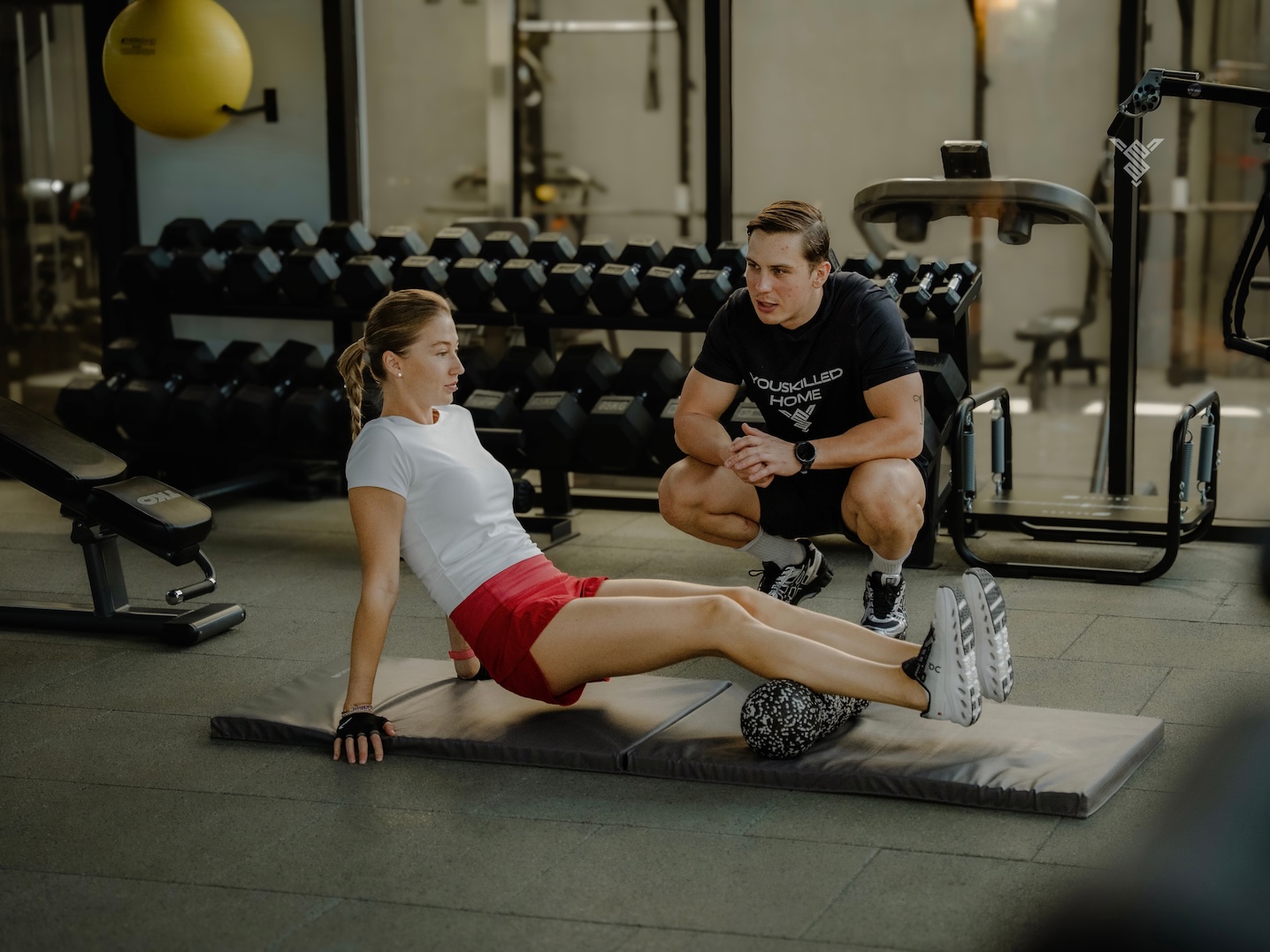
Personalized 1on1 Training | How YouSkilled Tailors Training Around Your Body’s Baseline
Personal training should begin with the person, not with a prewritten workout.
At YouSkilled Home, every one-to-one training program starts by understanding the member’s current baseline: how they move, what they can control, how much work they can tolerate, where they compensate, and how quickly they recover.
This initial assessment gives the coach a practical lens through which to understand the member’s fitness journey.
It helps answer an important question:
What does this person need most, and how can training develop it without ignoring the rest of the body?
The purpose is not to place every member into the same program.
The purpose is to build a clear structure around the individual and adapt that structure as their capabilities improve.
Why Personal Training Should Start With an Assessment
Most people know their general goals.
They may want to:
- lose body fat;
- become stronger;
- improve fitness;
- move with less stiffness;
- feel more energetic;
- return to exercise;
- prepare for an active lifestyle;
- become more confident in their body.
However, many people are not fully aware of the physical factors influencing those goals.
A new member may not know:
- how their joints move;
- where they lose control;
- whether one side works differently from the other;
- which exercises create compensation;
- how quickly they fatigue;
- how well they coordinate unfamiliar movement;
- how previous injuries still influence their mechanics;
- how much training stress they can currently recover from.
The assessment helps the coach look beyond the visible goal.
For example, two members may both want to lose weight, but one may have low cardiovascular capacity while the other lacks strength and movement confidence.
Giving both people the same workout would ignore the actual reasons their programmes should differ.
What Is a Physical Baseline?
A physical baseline is a practical picture of the member’s current abilities, limitations, experience, and recovery capacity.
It is not a judgement of whether someone is fit or unfit.
It is simply the starting point from which training decisions are made.
At YouSkilled, the baseline may include:
- Body weight and body-composition context
- Mobility
- Strength
- Coordination
- Awareness and control
- Endurance
- Recovery capacity
- Training and medical history
- Lifestyle and schedule
- Personal goals and preferences
These areas help the coach understand both what the member can currently do and what may need greater attention.
The YouSkilled Initial Assessment
The initial assessment is not designed to exhaust the member or prove how unfit they are.
It is designed to gather useful information.
The coach observes how the person responds to basic movement, resistance, coordination tasks, and manageable conditioning.
The exact assessment may vary according to the member’s age, experience, goals, health history, and current physical condition.
Step 1: Understand the Member’s Goal
The process begins with a conversation.
The coach needs to understand what the member wants to improve and why it matters.
Goals may include:
- improved body composition;
- better strength;
- increased endurance;
- less stiffness;
- greater movement confidence;
- more consistent training;
- preparation for recreational sport;
- improved energy;
- long-term health and independence.
The coach also considers the member’s expectations.
A useful program must connect the member’s desired outcome with a realistic training process.
Step 2: Review Training and Lifestyle History
The coach asks about the member’s previous experience with exercise.
This may include:
- sports background;
- previous personal training;
- gym experience;
- periods of inactivity;
- exercises the member enjoys;
- exercises they avoid;
- previous programs;
- reasons they stopped training;
- current weekly activity.
Lifestyle also matters.
A program for someone with regular sleep and a predictable schedule may look different from a program for someone who travels frequently, works long hours, or experiences high levels of stress.
The coach may discuss:
- working hours;
- sitting time;
- travel;
- sleep;
- family commitments;
- training availability;
- daily activity;
- recovery between sessions.
Personalization is not only about changing exercises.
It is also about building a program the person can realistically maintain.
Step 3: Consider Medical History, Injuries, and Precautions
Previous injuries, medical conditions, surgeries, pain, and physical restrictions must be considered before training progresses.
The coach may ask about:
- previous joint or muscle injuries;
- surgeries;
- recurring pain;
- accidents;
- rehabilitation history;
- current medical guidance;
- medications that may affect exercise;
- movements that create discomfort;
- exercises that have previously caused problems.
A personal trainer does not diagnose medical conditions.
When symptoms require clinical investigation, the member may need clearance or guidance from an appropriate healthcare professional.
The coach’s responsibility is to respect known precautions, avoid inappropriate loading, and adapt training within their professional scope.
Step 4: Observe Mobility
Mobility is the ability to access and control an appropriate range of motion.
The coach may observe areas such as:
- ankle movement;
- hip mobility;
- thoracic rotation;
- shoulder movement;
- overhead position;
- squat depth;
- trunk control;
- ability to move between positions.
Limited movement does not automatically mean that a person needs more stretching.
The restriction may relate to:
- joint range;
- muscle stiffness;
- weakness;
- fear;
- coordination;
- lack of familiarity;
- poor control in the available range.
The coach therefore looks not only at how far the member can move, but also at how well they control that movement.
Step 5: Assess Strength
Strength assessment does not always begin with maximal lifting.
For many members, the coach first observes how they handle basic resistance.
This may include:
- pushing;
- pulling;
- squatting;
- hinging;
- stepping;
- carrying;
- maintaining posture;
- controlling body weight;
- resisting rotation;
- producing force on each side.
The coach may look for:
- large differences between sides;
- loss of position;
- difficulty controlling the load;
- early fatigue;
- poor stability;
- compensatory movement;
- hesitation or lack of confidence.
The objective is to understand how the member currently produces and controls force.
Step 6: Assess Coordination
Coordination is the ability to organise different body parts into an effective movement.
Some members may have enough strength and mobility but still struggle to control a movement sequence.
Coordination can be observed through:
- locomotion;
- balance tasks;
- changes of direction;
- upper- and lower-body combinations;
- rhythm;
- movement transitions;
- single-leg tasks;
- unfamiliar patterns.
A member who struggles with coordination may need more repetition, slower progressions, and simpler movement structures before speed or resistance increases.
Step 7: Assess Awareness and Control
Body awareness is the ability to recognize position, tension, effort, and movement quality.
The coach may observe whether the member can:
- feel where their weight is distributed;
- control breathing;
- recognize when posture changes;
- adjust after feedback;
- distinguish muscular effort from discomfort;
- understand movement instructions;
- maintain technique under fatigue.
A person may physically have the capacity to complete an exercise but lack the awareness to recognise when the movement is changing.
Improving this awareness is an important part of becoming physically skilled.
Step 8: Assess Endurance and Work Capacity
Endurance assessment helps the coach understand how the member responds to sustained or repeated effort.
This does not require an all-out fitness test.
The coach may use manageable work such as:
- walking;
- cycling;
- rowing;
- step work;
- repeated bodyweight exercises;
- light circuits;
- timed movement;
- controlled intervals.
The coach observes:
- breathing;
- pacing;
- heart-rate response where appropriate;
- movement quality under fatigue;
- recovery between efforts;
- ability to follow instructions while working;
- whether fatigue rises gradually or suddenly.
The goal is to understand how much work the member can currently tolerate while maintaining useful quality.
Step 9: Assess Recovery Capacity
The same workout can affect two people very differently.
One member may recover quickly, while another may experience prolonged soreness, low energy, or reduced performance for several days.
The coach therefore considers:
- sleep quality;
- energy;
- stress;
- soreness;
- training frequency;
- nutrition and hydration habits;
- response to previous exercise;
- recovery between sets;
- readiness during the warm-up.
Recovery capacity influences how much training can be prescribed and how quickly progression should occur.
What the Coach Learns From the Assessment
The assessment helps identify the member’s highest-priority needs.
For example:
A Member With Low Cardiovascular Capacity
This person may become breathless quickly, struggle to recover between exercises, or lose movement quality as fatigue rises.
The program may place greater emphasis on:
- aerobic base development;
- controlled intervals;
- pacing;
- breathing;
- muscular endurance;
- gradual work-capacity progression.
A Member Who Lacks Stability
This person may have difficulty controlling joints or maintaining position under load.
The program may include more:
- supported strength work;
- unilateral exercises;
- trunk control;
- slower tempos;
- balance;
- controlled range of motion;
- progressive loading.
A Member With Mobility Restrictions
This person may struggle to access positions required for certain exercises.
The program may include:
- active mobility;
- movement preparation;
- alternative exercise positions;
- strength through available ranges;
- gradual range development;
- reduced load until control improves.
A Member With Good Fitness but Poor Movement Control
This person may be able to work hard but compensate during movement.
The program may temporarily reduce speed, complexity, or load so the member can improve:
- technique;
- alignment;
- coordination;
- control;
- consistency under fatigue.
A Member Returning After Inactivity
This person may have previous training experience but reduced tolerance to volume and intensity.
The program may begin below their remembered ability and rebuild:
- tissue tolerance;
- cardiovascular capacity;
- movement familiarity;
- training frequency;
- recovery confidence.
Why Compensations Matter
A compensation occurs when the body finds another way to complete a task.
Compensation is not always automatically dangerous. The body naturally adapts movement according to structure, experience, fatigue, and available capacity.
However, repeated compensation can become relevant when it:
- creates discomfort;
- reduces control;
- shifts excessive stress to another area;
- worsens as load or speed increases;
- limits progression;
- reflects an unresolved restriction or weakness.
This matters because higher force magnifies the demands of a movement.
If a member cannot control a pattern at a manageable level, simply adding more weight, speed, impact, or fatigue may reinforce the same problem.
The coach should first decide whether the movement can be improved, modified, or replaced.
Intensity should not be used to hide a lack of control.
Previous Strain and Injury History
A member’s current body reflects years of movement, work, training, inactivity, accidents, and previous injuries.
This history may influence:
- range of motion;
- confidence;
- side-to-side differences;
- preferred movement patterns;
- tolerance to impact;
- tolerance to resistance;
- recovery.
A personalized program should not treat the body as if it has no history.
It should recognize that the member may need a different path toward the same general goal.
From Assessment to Custom Program
Once the coach understands the member’s baseline, the next step is to organise the programme.
The goal is not to create random variety.
It is to build a structure that addresses the member’s priorities while continuing to develop the whole body.
1. Define the Main Training Emphasis
The coach identifies the areas that currently need the most attention.
This may include:
- cardiovascular fitness;
- basic strength;
- stability;
- mobility;
- coordination;
- body composition;
- work capacity;
- movement confidence;
- recovery.
A member may have one main priority and several supporting priorities.
2. Select Suitable Movements
Exercises are selected according to:
- purpose;
- movement ability;
- available range;
- coordination;
- strength;
- confidence;
- injury history;
- training experience;
- equipment;
- recovery cost.
The best exercise is not always the most complex exercise.
It is the exercise that creates the intended training effect at an appropriate level of risk and difficulty.
3. Select the Starting Dose
The coach determines:
- load;
- repetitions;
- sets;
- rest;
- speed;
- range of motion;
- training density;
- session duration;
- weekly frequency.
The starting point should create enough challenge to stimulate adaptation without producing unnecessary disruption.
4. Combine the Session Structure
A custom session may include:
- Readiness check
- Movement preparation
- Skill or mobility work
- Strength training
- Endurance or conditioning
- Supporting exercises
- Recovery or cool-down work
The amount of time given to each section depends on the member’s needs.
5. Track the Member’s Response
The coach observes how the member responds during and after training.
Important information may include:
- technique;
- confidence;
- effort;
- pain or discomfort;
- breathing;
- recovery between sets;
- load tolerance;
- soreness;
- energy before the next session;
- ability to repeat the movement.
The program is adjusted according to evidence, not only according to the original plan.
How the Program Evolves
Personalization is not a one-time decision made during the initial assessment.
The member changes.
As strength, mobility, coordination, endurance, and confidence improve, the programme should change with them.
A movement can progress through:
- greater range;
- less assistance;
- more resistance;
- additional repetitions;
- slower control;
- higher speed;
- increased stability demand;
- more complex coordination;
- shorter recovery;
- greater total work.
However, progression does not always mean making an exercise harder.
Sometimes the correct progression is:
- better technique;
- more consistency;
- less discomfort;
- smoother breathing;
- improved confidence;
- faster recovery;
- greater tolerance to weekly training.
The coach’s job is to recognise which form of progression is most useful at that stage.
A Custom Program Is Structured, Not Random
Personalized training does not mean inventing an entirely different system for every member.
It means applying a clear system according to the individual.
At YouSkilled, the program may continue to develop the same broad physical qualities:
- skill;
- strength;
- mobility;
- endurance;
- body composition;
- recovery.
What changes is:
- the emphasis;
- the exercise selection;
- the starting level;
- the progression;
- the volume;
- the intensity;
- the coaching approach.
The framework stays consistent while the application becomes personal.
Generic Workout Plan vs YouSkilled PersonaliZed Strategy

What We May Track Over Time
To understand whether the custom plan is working, the coach may monitor:
- attendance;
- body weight and body-composition trends;
- movement quality;
- usable range of motion;
- strength;
- work capacity;
- coordination;
- exercise confidence;
- rate of perceived effort;
- recovery between exercises;
- soreness;
- energy;
- tolerance to weekly training;
- pain or physical limitations;
- ability to manage more complex tasks.
Not every measure needs to improve at the same time.
The program may prioritize one capacity while maintaining others.
Is Personalized Training Only for People With Injuries?
No.
Individualization is useful for beginners, experienced members, older adults, busy professionals, recreational athletes, and people with no current injuries.
Even two healthy people of the same age and body weight can differ significantly in:
- coordination;
- mobility;
- strength;
- endurance;
- confidence;
- exercise history;
- recovery;
- lifestyle;
- goals.
Personalization is not only a response to limitations.
It is a way to make training more relevant, efficient, and sustainable.
Is YouSkilled Suitable for Beginners?
Yes.
Beginners often benefit significantly from one-to-one coaching because they are still developing:
- movement vocabulary;
- body awareness;
- training confidence;
- breathing control;
- familiarity with resistance;
- understanding of fatigue;
- consistency.
A beginner does not need a simplified version of an advanced athlete’s programme.
They need a program designed around the skills and capacities they are currently ready to develop.
Where Is YouSkilled Located?
Youskilled is an appointment-only personal training studio located at:
Villa 18A
Umm Amara Street
Al Wasl, Dubai
The studio is located near Jumeirah and City Walk and is accessible from areas including Downtown Dubai, Business Bay, DIFC, Satwa, Jumeirah 1, Jumeirah 2, Jumeirah 3, and surrounding communities.
The private environment allows coaches to organise the training space and equipment around each member’s programme.
Frequently Asked Questions
- What happens during a personal-training assessment?
A personal-training assessment usually includes a discussion of goals, exercise history, lifestyle, injuries, and limitations, followed by observation of movement, mobility, strength, coordination, endurance, and recovery response.
- Does YouSkilled give every member a different program?
Each member follows an individual program, but the program is built within the Youskilled Training System. The broad framework remains consistent, while the emphasis, exercises, intensity, volume, and progression are adapted to the person.
- Can a beginner do personalized personal training?
Yes. Personalized coaching can help beginners learn movement, control, breathing, resistance, and effort from an appropriate starting level.
- Will the assessment diagnose injuries?
No. A personal trainer can observe movement and consider known limitations, but medical diagnosis must be performed by an appropriately qualified healthcare professional.
- What happens if an exercise feels uncomfortable?
The coach reviews the movement, resistance, range, and type of discomfort. The exercise may be adjusted, replaced, or stopped. Unexplained, sharp, worsening, or persistent symptoms may require medical assessment.
- How often is the program changed?
The program evolves as the member’s capability, goals, recovery, and schedule change. Exercises are not changed only for novelty. Changes should serve a clear training purpose.
- Does personalized training mean every session is completely different?
No. Repetition is necessary for skill and progress. Sessions should contain enough continuity for the member to improve, with appropriate changes in load, volume, range, complexity, and emphasis.
- How does YouSkilled measure progress?
Progress may be measured through body composition, strength, mobility, endurance, movement quality, work capacity, recovery, confidence, and consistency.
The Art and Science of Individual Training
Personal training requires both structure and judgement.
The science provides principles for:
- progression;
- loading;
- recovery;
- movement;
- strength;
- endurance;
- adaptation.
The art is deciding how those principles should be applied to the individual standing in front of the coach.
The same goal can require different paths.
One member may first need cardiovascular capacity. Another may need stability. Another may need mobility, coordination, confidence, or a more manageable relationship with fatigue.
The coach’s task is to combine these needs into one practical route toward becoming fitter and more physically capable.
The program should not ask your body to become someone else’s body. It should develop the body you have from the baseline where you are today.
Build a Program Around Your Body
YouSkilled provides personalized one-to-one personal training in Al Wasl, Dubai.
Every program begins with an understanding of the member’s goals, movement, strength, mobility, coordination, endurance, history, and recovery capacity.
As the member develops, the programme develops with them.