
Can You Rebuild Strength After Years Without Training? Yes—Here’s How
Yes. Strength can be rebuilt after years without training, and the process does not need to start with heavy weights.
When someone has been inactive for a long time, the first goal is not to prove how strong they used to be. The first goal is to give the body a reason to become capable again.
Strength returns through progression.
You start with what the body can control today, then gradually ask it to do more.
Step 1: Teach the body to tolerate force again
After years without training, even normal positions under load can feel unfamiliar.
This is where simple, controlled exercises are useful. Static holds and slow movements can help a person learn how to create tension, hold a position, and become comfortable supporting their own bodyweight.
For example, a coach might use:
- supported squat holds
- split-stance holds
- plank variations
- controlled bridge positions
- supported carries
- slow isometric or paused positions
The objective is simple:
Make the body comfortable producing and controlling force again.
This stage is not about exhaustion. It is about control and tolerance.
As the person becomes more comfortable, the exercises can become more demanding.
Step 2: Build strength through a full range of movement
Once the person can control basic positions, the next step is to make that strength useful while the joints move.
A muscle does not only need to be strong in one position.
It needs to produce and control force through the ranges that life and training require.
That means gradually moving from static positions into controlled movements:
squat, hinge, push, pull, lunge, carry and other basic patterns.
The resistance stays appropriate to the person's current ability.
The goal is:
More range. More control. More usable strength.
This is where the body starts to feel different. Movements that initially felt stiff or uncertain become more natural.
Step 3: Build the ability to repeat work
Being strong once is different from being strong repeatedly.
After years without training, a person may be able to perform one good repetition but fatigue quickly when repetitions accumulate.
The next stage is therefore muscular endurance and work capacity.
You gradually increase:
- repetitions
- sets
- time under tension
- controlled conditioning
- total work
The person learns to maintain technique while working.
That matters because real life rarely asks for one perfect repetition.
It asks you to keep going.
Step 4: Introduce external resistance
Now the body is ready to handle more meaningful resistance.
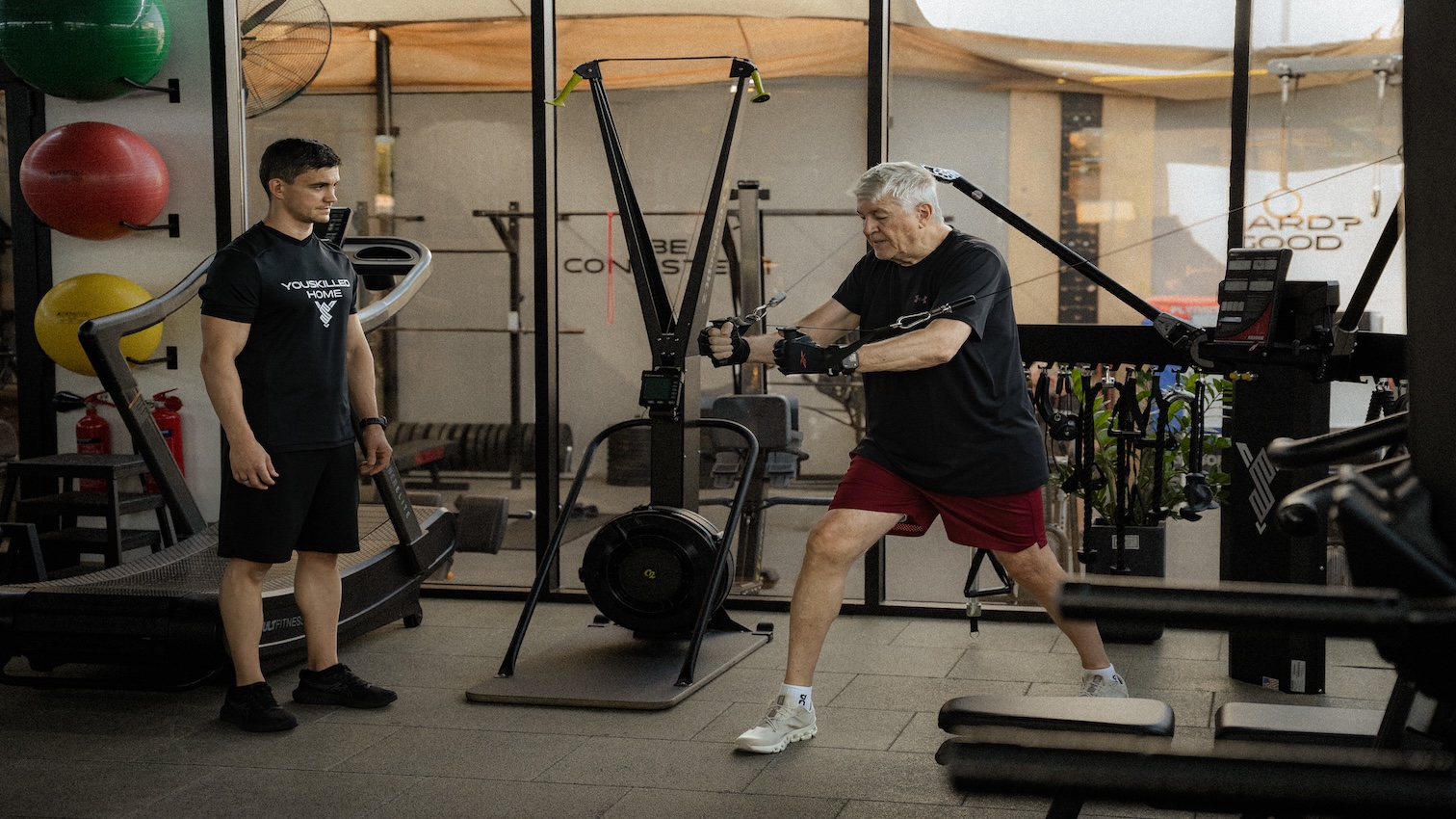
Dumbbells, cables, barbells, machines or other forms of resistance can be introduced according to the person and the movement.
The weight does not have to be heavy.
It simply has to be challenging enough to require adaptation and appropriate enough to recover from.
Modern resistance-training evidence supports tailoring load and volume to the individual's goal and capacity rather than relying on one fixed prescription.
The progression might look like:
bodyweight → controlled resistance → more repetitions → more load → more complex movement
The important thing is that progression is earned.
Step 5: Build strength that lasts
Once resistance becomes part of training, the goal changes again.
We are no longer simply rebuilding what was lost.
We are developing a body that can continue improving.
The coach can progressively increase resistance, volume, movement complexity and work capacity while keeping technique under control.
This is how strength becomes sustainable.
And this is where training becomes interesting.
You stop thinking about what you used to be able to do.
You start seeing what you can do now.
How long does it take to rebuild strength?
There is no single timeline.
Someone who has been inactive for six months is different from someone who has been inactive for ten years. Age, previous training history, body composition, health status, sleep, nutrition and consistency all affect the rate of progress.
The good news is that the return does not need to be dramatic.
The first signs can be simple:
A movement feels easier.
You can hold a position longer.
You can perform more repetitions.
You recover faster between sets.
You can use a little more resistance.
Your technique becomes more natural.
Those small improvements accumulate.
The important principle
The body does not need to be punished back into shape.
It needs to be progressively reminded what it is capable of.
Start with control.
Build range.
Build endurance.
Add resistance.
Progress gradually.
Repeat.
That is how years away from training can become the beginning of a stronger body rather than a permanent limitation.
At Youskilled
Rebuilding strength starts from the person's current capacity, not the level they remember having years ago.
The coach assesses where the body is today, establishes the first level of work, and progressively develops strength, endurance, mobility and movement skill from there.
You don't need to be strong before you start training. Training is how you become strong again.